
Easter Thoughts
Jesus and the Crucifixion in the Qur'an

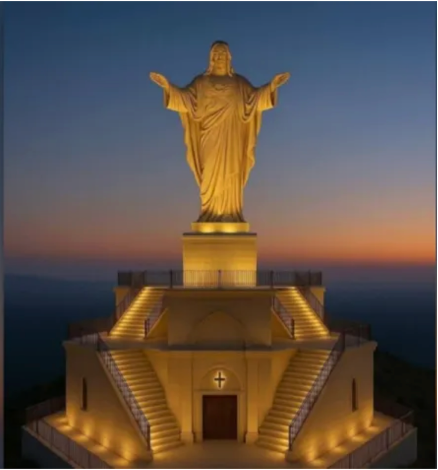
El-Qaa, Bekaa Valley, Lebanon
Then she came with him unto her people, carrying him. They said, “Oh Mary! You have certainly committed a strange thing.
Oh sister/kinswoman of Aaron! Your father was not an evil man, nor was your mother unchaste.”
Then she pointed to him. They said, “How can we speak to one who is still a child in the cradle?”
He said, “Truly I am a servant of God. He has given me the Book and made me a prophet.
He has made be blessed wherever I may be, and has enjoined upon me prayer and almsgiving for as long as I live,
and to be good to my mother. And He has not made me arrogant and wretched.
Peace be upon me the day I was born, the day I die, and the day I shall be raised alive!”
~ Qur’an 19:27-33
With Good Friday and Easter upon us, I find my mind wandering through the many verses in the Qur’an that speak of Jesus and his mother, Mary, and my heart warms to the blessing of having had this scripture accompany me throughout my life. And it occurs to me that the reverence accorded in that holy book to these two blessed beings may be something some readers are not aware of, or if they are, perhaps it’s nevertheless worth touching on the extent of their integration with the Islamic worldview.
As I have mentioned elsewhere, Jesus – ’Issa in Arabic— is mentioned 25 times by name in the Qur’an as well as by various titles such as the Messiah, Word of God, Word from God, Spirit from God, and Son of Mary. Biblical and other stories of his life are retold in the Qur’an, including his virgin birth (e.g. 3:47, 21:91, 66:12), speaking from the cradle (e.g. 3:46, 5:110), animation of a clay bird (3:49, 5:110), healing of the blind and the leper (3:49, 5:110), and raising of the dead (5:110). Mary is mentioned 34 times, and she is described as the highest-ranking woman in all of creation (3:42).
Chapter Three in the Qur’an, The House of ‘Imran (i.e. Joaquim), is named after Mary’s father and is one of the longest. Chapter Five’s title, The Banquet, is a reference to the Last Supper of Jesus with his disciples. Chapter Nineteen is titled, simply, Mary (Maryam in Arabic).
And in addition to all these affirming and reverent verses, there are others that are like gems that have a particular shine to them, I have always felt, such as:
…And We gave Jesus son of Mary clear proofs, and strengthened him with the Holy Spirit... (2:87)
Having said all this, it must be said though that when it comes to the Crucifixion and Resurrection of Jesus, Muslims have generally had a different take on things from the Christian belief. Classical Islamic scholarship has maintained that Jesus was saved from crucifixion and was raised to heaven by God instead, a belief based on how the following two verses have historically been understood:
And for their saying, “We slew the Messiah, Jesus son of Mary, the messenger of God” – yet they did not slay him nor crucify him, but so it appeared to them…
But rather God raised him up to Himself, for God is Mighty, Wise. (4:157-158)
The“but so it appeared to them” part, in other words, has been taken literally to mean that while the perpetrators thought they were crucifying Jesus, they were only crucifying a being miraculously made to look like him. To date, there has not been a debate about a possible alternative understanding of these verses, one where this verse would be heard as in fact confirming the Resurrection that came right on the heels of the Crucifixion, with God essentially saying: “You thought you had crucified and killed him because you destroyed his body, yet I have immediately raised him from the dead and brought him to Me.” To my mind, the latter interpretation would moreover tie in with the last verse of the opening passage cited above - though I am aware that this could be said to apply to all of us since we will all be raised after death according to scripture, except that none of us but Jesus spoke these words from the cradle:
Peace be upon me the day I was born, the day I die, and the day I shall be raised alive! (19:33)
It is understandable, to a large extent, why greater debate in the Islamic world has not taken place over a more nuanced meaning of these two verses referencing the Crucifixion in the Qur’an. Every society has historically focused on more immediate and practical concerns before it and less so on reconciling theological or philosophical differences with other communities. Much of the Muslim world since inception has additionally had long periods of dealing with more existential concerns, from medieval times to the colonial period all the way through to the contemporary era. Nonetheless, and despite this divergence in the general Muslim understanding of the Crucifixion from the Christian one, it has not diminished Muslim belief in Jesus as such, nor the reverence in which he is held in Islam as the Messiah, son of Mary, and messenger of God.
May we dwell on and celebrate our commonalities during this holy week and beyond, and together pray for peace in the lands of Jesus’s birth and ministry.
~ Seasonal Tidbit ~
In addition to locations throughout Israel and Palestine which are familiar to many, several other sites in neighbouring Lebanon are associated with Jesus’s life. Here are the most famous:
Qana, aka Cana (South Lebanon): This village is widely considered to be the place where Jesus performed his first miracle, turning water into wine. Archaeological findings include ancient water basins and caves associated with the event.
Our Lady of Mantara (Maghdoucheh): Known as “Our Lady of Waiting,” this site includes a cave-shrine near Sidon where, according to tradition, the Virgin Mary waited for Jesus while he preached in coastal cities.
Sidon and Tyre & environs e.g. Sarafand (Zarephath): The Bible (Matthew 15) indicates that Jesus traveled to this coastal region, where he encountered a Canaanite woman and preached. These regions hold many ancient churches and sites where early Christians congregated, maintaining the memory of his visit.
El-Qaa (Bekaa Valley): In March 2026, a massive statue of “Jesus the Redeemer” was installed on Jabal al-Salib (Mount of the Cross), marking a significant spiritual landmark in the region (see image above).
A big “thank you” to my pioneering paid subscribers! Your contribution helps keep this publication going
Click on What Lies Within for previous posts. Every “like” & “restack” from the website or app extends a post’s reach, so thank you in advance!
Many wisdom traditions, histories and philosophies offer us much that reassures and offers hope. Together, we can build on them constructively, for the greater good. I aim to inspire and surprise by publishing at least 2 columns/posts a month, nipping back and forth between historically fascinating examples and more personal, experiential ones: more and more of us are living spiritual lives that were once the domain of hermits, recluses and religious orders alone, and we need to share what we learn and support one another at this juncture in humanity’s journey through our world..
P.S. For more of my writing, also check out my best-selling book No Truth Without Beauty: God, the Qur’an, and Women’s Rights. Thank you!
Thank you for this enlightening article. I find such value in learning about what the Quran teaches about Jesus and Mary. 🩵
Dear Leena, this is a powerful and enlightening article that reminds us how much Christianity and Islam have in common—far more than people care to admit. Of the locations you mentioned below I have only been to Qana , the place of Jesus Christ’s miracle, filled me with a profound sense of reverence.